Four rows of terminals.
A stepped layout makes room for connections within the narrow enclosure.
kolosDrive12
Listen to kolosAQ temperature and air-quality data. Drive 24 V heating valve actuators and ventilation servos. Define the response in your own script.
Try temperature control ↓Buy · €149 ↗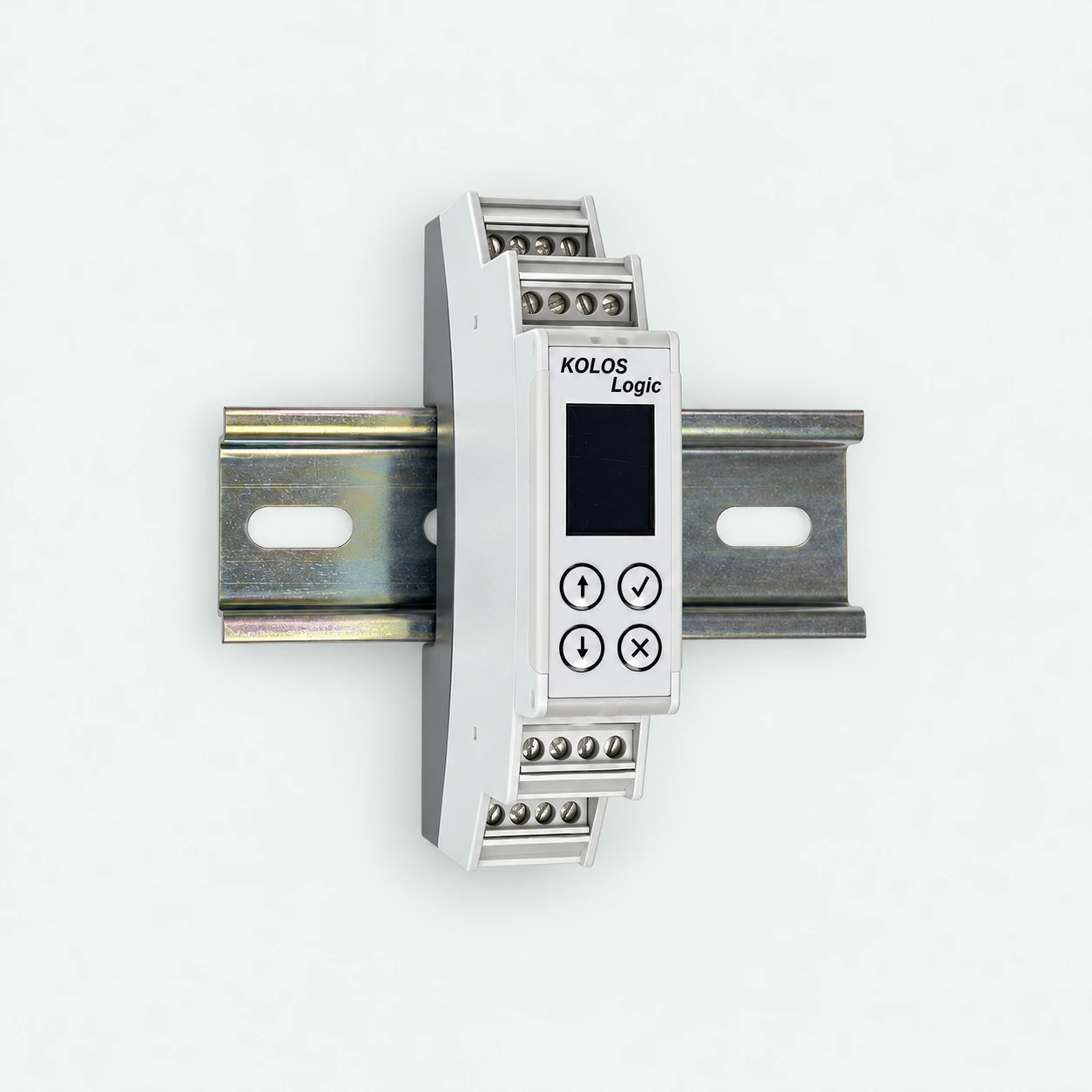
THE SAME COMPACT ENCLOSURE. TWO DIFFERENT CONTROLLERS.
Four rows of terminals keep the connections stacked, not spread across the cabinet. Both controllers fit in a single 17.8 mm-wide unit, with an OLED display and four buttons on the front.
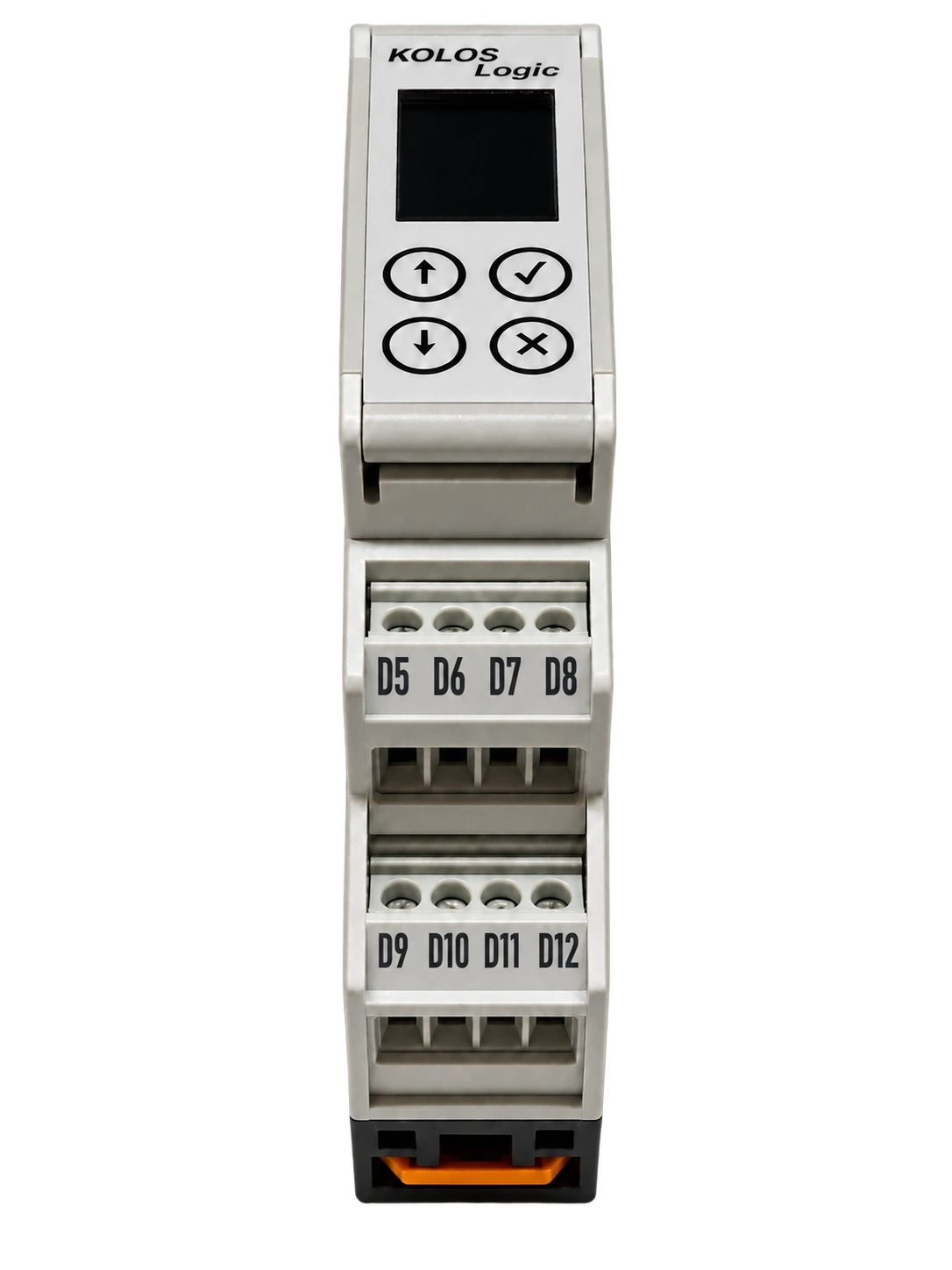
Just one unit wide.
A stepped layout makes room for connections within the narrow enclosure.
A display and physical controls built into the front. Your script defines how they work.
The same physical format for kolosDrive12’s on/off/PWM outputs and kolosControl64’s inputs and analog outputs.
CONTROL THAT STAYS IN THE ROOM
Choose the kolosAQ readings that your application needs. Temperature for heating; air-quality data for ventilation demand.
Write a script or create one with AI assistance using the language documentation. Review it, then load it over Bluetooth.
The uploaded program runs on kolosDrive12, independently of the Mac connection.
ONE CONTROLLER. YOUR APPLICATION.
Use temperature from kolosAQ to decide when a heating valve actuator should respond.
Use the room’s air-quality data in your own ventilation logic, driving on/off/PWM servos.
Add external relays to switch 230 V actuators from your controller program.
YOUR REQUIREMENTS. YOUR PROGRAM.
KOLOS controllers ship without a preloaded application. A documented scripting language lets you define what the hardware does. Write the script yourself, or ask AI to help turn your requirements into one.
Describe the sensors, connected equipment and behavior you want. Give your AI assistant the KOLOS language documentation.
Review the generated script, its input and output assignments, and what should happen if sensor data stops arriving. Compile and check it before use.
Load the program onto the controller. The logic then runs locally, without the AI assistant or your Mac needing to stay connected.
“Use the room sensor to control a 24 V heating valve around my chosen temperature. Define what the output should do if fresh readings stop arriving.”
Describe the result you want. Review and test your script, then make it your own.
AND OF COURSE, TEMPERATURE TOO.
One room. Two comfort settings. Switch between heating and cooling, with a separate target for each.
HYST() takes care of the small switching band. Inside it, the valve keeps its previous state instead of switching back and forth.
SWITCH cooling = FALSE
  LABELS 'Heating', 'Cooling';
PARAM heatingTarget = 21.5 RANGE 16.0..26.0
  LABEL 'Heating setpoint';
PARAM coolingTarget = 24.0 RANGE 18.0..30.0
  LABEL 'Cooling setpoint';

ON SAMPLE(room)
BEGIN
  IF cooling THEN
    valveClosed := NOT HYST(
      room.temperature, coolingTarget, 0.2)
  ELSE
    valveClosed := HYST(
      room.temperature, heatingTarget, 0.2);
END;
Define a switch and setpoints in your script; they appear as controls in KOLOS for Mac. Switch labels run left to right: Heating (FALSE), Cooling (TRUE). In this valve setup, HIGH closes the valve and LOW opens it. NOT reverses the response for cooling.
SPECIFICATIONS
Twelve on/off/PWM outputs in a single DIN-rail unit. Write your logic, load it over Bluetooth, and let kolosDrive12 take care of the response.
BEFORE YOU PLAN AN INSTALLATION
Connect 24 V heating valve actuators or ventilation servos using on/off or PWM control, up to 250 mA per output. External relays let you switch higher-voltage loads.
No, the uploaded controller program runs autonomously. The Mac is used for setup, monitoring while connected and changing the setpoint.
Yes. Use kolosAQ air-quality readings in your script to control ventilation servos as conditions change.
Yes. Your script controls twelve on/off/PWM outputs, rated up to 250 mA each.
The controller is sold empty, without a preloaded application. Use the documented language to write a script, or ask AI to help generate one for your requirements. Review and test it, then load it over Bluetooth.
Get to know the sensor behind the temperature input.
Explore kolosAQ ↗